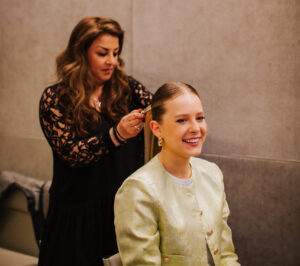
Hair and makeup has an interesting habit of being squeezed into whatever time remains on a production schedule… and then everybody wonders why the hair and makeup artist is asking for another ten minutes.
We’ve spent more than 15 years working across TV, film, corporate production, livestreams, interviews, and events, and if there’s one piece of advice we’d give a producer planning a filming day, it’s this:
Give hair and makeup the right information and enough time at the beginning, and we’ll probably save you time later.
Here’s what actually helps.
Why do you need professional hair and makeup for corporate filming?
Well, not everybody does.
Yes, we said it.
If the circumstances don’t warrant a hair and makeup artist, we’re not going to invent a reason you need three of us for eight hours.
But when somebody is going to be a significant focus of professional footage, experienced on-set hair and makeup can make an enormous difference.
Professional lighting and cameras can emphasise shine, uneven skin tone, flyaway hairs, tiredness, and other small details that may barely register in everyday life.
Our job is to make sure none of those things distract from what the person is actually there to say.
That’s the technical part.
The other part is the human sitting in our chair…
And producers sometimes underestimate that one.
Hair and makeup is often the beginning of someone’s filming day
Imagine you’re filming your CEO.
They’ve arrived five minutes late after three calls, slept badly, have a board meeting later, and don’t particularly want to be on camera in the first place.
Where do they go first?
Quite often, us.
That time in the makeup chair gives them an enforced moment to stop.
A good artist can read whether somebody needs conversation, distraction, reassurance, quiet, or simply a chance to collect themselves.
Meanwhile, we’re getting them physically ready.
So by the time they stand up, they don’t just look different… they’ll feel different.
That’s particularly important in corporate production because we’re rarely working with professional actors or models.
We’re preparing real people who happen to need to perform on camera that day.
How much time should you allow for hair and makeup?
There isn’t one standard answer but as a rough guide:
Male grooming: from approximately 5 minutes
Express female camera-ready touch-up: around 15 minutes
Individual hair or makeup: approximately 30–45 minutes
Full corporate hair and makeup: approximately 45 minutes -1 hour, sometimes up to an hour and a half.
A creative campaign or more involved styling can take longer.
But the number of people is only half the equation.
The really important question is:
When does everybody need to be camera-ready?
Six contributors don’t necessarily require six people to be finished at 9am.
If two are filming first while we’re preparing the remaining four, one or two artists may comfortably handle the schedule.
If all six need to stand together in front of the camera at 9am?
Different story.
Give us the running order and let us work backwards.
Please don’t simply cut the hair and makeup time
This is one of the easiest ways to create a problem that only becomes visible when it’s too late.
Production schedules move – we understand that – but repeatedly asking the artist:
“Can you do it in half the time?”
doesn’t magically make the same work happen twice as quickly.
Experienced artists work fast already.
If we say we need a particular amount of time, it’s because we know what has to happen before that person goes in front of the camera.
Cutting corners at the beginning can mean living with those corners in the finished footage.
What does “straight and corrective makeup” mean?
Corporate filming doesn’t generally require glamorous makeup.
Quite often we’re doing the opposite.
Straight and corrective hair and makeup is about subtly correcting things that could unnecessarily attract the viewer’s attention.
Perhaps that’s shine.
Perhaps it’s tiredness under the eyes.
Perhaps somebody has a blemish that appeared that morning.
Perhaps their hair has a particularly determined flyaway.
We’re not trying to erase every sign of being human, we’re making sure the viewer is not distracted and intently listening to:
“Here’s our company’s strategy for the next five years…”
rather than thinking:
“What is that little thing on his forehead?”
Tiny distractions become considerably less tiny when someone’s face fills a screen.
What does professional lighting do to hair and skin?
Lighting can change the way colour, texture, shine and definition appear on camera.
Strong studio lights can also become warm over time, which means someone who looked beautifully camera-ready at 9am may become increasingly shiny as filming continues.
People get tired too.
They’ve been sitting under lights, concentrating, repeating takes, and possibly forgetting to drink enough water or eat.
That’s when an on-set artist becomes particularly useful.
We’re watching for the little changes as the day progresses and stepping in when needed.
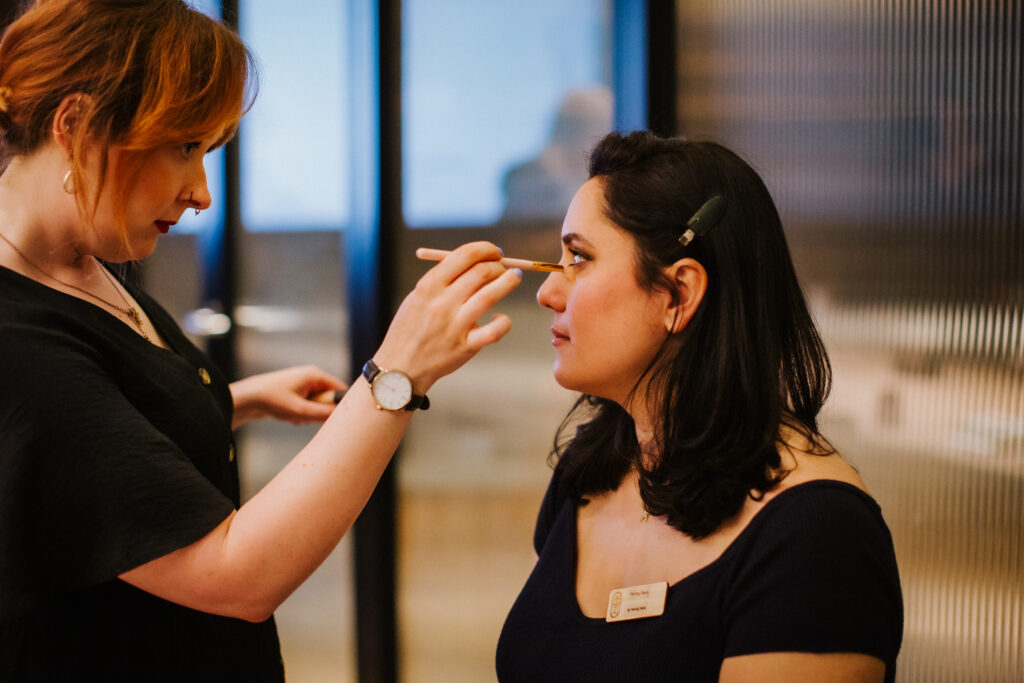
What is the hair and makeup artist doing once filming starts?
Sometimes it looks like we’re just standing there…
But we’re not doing nothing.
We’re watching.
Depending on the production, we’re checking the monitor and the talent for:
shine developing under the lights,
hair moving between takes,
flyaways,
lip colour wearing away,
smudging,
skin changes,
continuity,
clothing details that somebody else may have missed.
Everyone on set has their own focus.
The director is watching performance.
Production is watching the schedule.
Sound is listening.
Lighting is looking at lighting.
Talent is concentrating on what they need to say and do.
We’re looking at the person. That’s our job.
Should a hair and makeup artist stay for the entire filming day?
If budget allows and you’re filming significant talent for several hours, it can be extremely valuable… but that doesn’t mean it’s always necessary.
For a short interview, we may be able to prepare someone, check them on camera and leave.
For straightforward headshots, ongoing support is rarely required.
For a full filming day with several contributors, repeated takes or senior talent, we’d be much more likely to recommend having someone remain on set.
And there’s another benefit:
talent stops worrying about how they look.
They know somebody else is watching that for them and, that frees them to concentrate on the job.
What does hair and makeup need on location?
Give us a beautiful dedicated hair and makeup suite with daylight, high chairs, mirrors, tables and access to power sockets and we’ll love you forever!
But we’ve also worked from cupboards and car boots.
We’ll cope.
Ideally, though, we’d like:
a reasonable amount of space,
a chair – preferably higher if available,
a table or surface,
good light or room for us to bring lighting,
access to power where required,
and, if we’re staying for filming, sensible access to the set or monitors.
The physical environment matters for another reason too.
If your nervous presenter is being prepared in the middle of a chaotic room with fifteen people rushing around them, that affects how they feel.
A little calm before somebody performs can be enormously valuable.
What should you tell contributors before the filming day?
Keep it simple.
Tell them they’re going to be looked after.
Let them know hair and makeup will be there, what time they need to arrive and approximately what the process will involve.
If possible, tell us in advance about any particular concerns, allergies, or requirements.
If someone is deeply uncomfortable wearing makeup, we’d rather know before they arrive.
We can adapt.
For hair, clean hair is generally ideal, often washed the previous day when styling is required as freshly washed hair can be quite slippery and doesn’t always like to play ball.
Most importantly, ask people to arrive with enough time that they aren’t already panicking before they’ve sat down.
What if somebody arrives late?
Welcome to production!
Again, we’ll adapt.
An experienced team can often rearrange the order, prepare somebody else first, or work with production to adjust who films when.
Unexpected contributors appear too…
Schedules change…
Filming overruns…
And this is why we place so much value on our artists who are calm and proactive rather than simply technically talented.
The person fixing the problem should not become another problem.
How many hair and makeup artists do you need?
Again, work backwards from your camera-ready time.
If we’re providing express grooming, one artist can prepare a surprisingly large number of people over a day.
If everybody requires fuller hair and makeup, the number drops considerably.
If you have a tight morning schedule, multiple artists may be the sensible answer.
For larger productions, we can also split the work – for example, one artist working predominantly on hair while another handles makeup.
This is one of the advantages of working with an established team rather than sourcing several unrelated freelancers individually.
We can build the team around the production.
What should you include when briefing your hair and makeup team?
At minimum, we’d like to know:
- date and location
- number of contributors
- who requires hair, makeup or grooming
- when each person needs to be camera-ready
- expected finish time
- what you’re filming
- whether you want the artist to remain on set
- and any particular requirements or concerns
Photographs of the talent in advance are helpful.
So are creative references.
For campaigns, the more of the wider creative brief we can see, the better.
We’re not precious about staying inside our little hair-and-makeup-shaped box either.
We like collaborating… in fact, we love it!
If we spot something useful, we’ll tell you.
Experienced artists make productions easier.
Technical hair and makeup skill matters.
But on a corporate filming day, it’s only part of the job.
The best on-set artists are also quick, observant, personable, calm, adaptable, and able to work as part of a wider crew without needing to be managed.
They know when to step forward… and they know when to disappear.
They know how to reassure somebody who’s nervous, work around somebody who’s late, and keep an eye on the details while everybody else is concentrating on their own role.
Because ultimately, great production hair and makeup should make your life easier – not give you another thing to manage.
Planning a filming day?
CJC Hair & Makeup provides experienced on-set hair and makeup artist for corporate filming, interviews, livestreams, brand content and productions in London, throughout the UK and internationally.
Tell us your running order, talent numbers and brief and we’ll recommend the right level of support.
By Camilla Collins.
Camilla Collins is the founder of CJC Hair & Makeup, leading a team of experienced hair and makeup artists working across corporate production, weddings, events, TV, film and live appearances.
With more than 15 years of industry experience, Camilla specialises in the relationship between appearance, confidence and how people show up when it matters.